
ELD Mandate Exemptions: Who Needs an ELD in 2026?
A federal ELD exception may remove the device requirement without removing paper logs or hours-of-service duties. Use the decision gate and verified matrix below before choosing a device.
Federal rules verified August 9, 2026.
Short answer. Most interstate drivers of commercial motor vehicles who must keep records of duty status (RODS) are required to use an electronic logging device (ELD). That one sentence carries the whole test: the federal ELD requirement follows the duty to prepare RODS — not your vehicle type, CDL status, authority age, or anything a broker or device vendor told you.
The Two-Exit Rule. There are two very different ways to be free of the device requirement, and they leave different paperwork behind:
- Exemptions from RODS itself. A qualifying short-haul day and certain other exemptions in 49 CFR Part 395 remove the record-of-duty-status duty for that day — no RODS, no ELD — but the motor carrier must still keep accurate time records.
- ELD-only exceptions. The 8-in-30, driveaway-towaway, and pre-model-year-2000 paths in 49 CFR 395.8(a)(1)(ii) let a driver keep handwritten RODS when RODS are otherwise required. The logs do not go away; the device does.
"No ELD required" never automatically means "no records required." Every path on this page states exactly which records remain, and each rule links to the current federal text so you can verify it before acting on it. First Load HQ is an independent publisher with no affiliation with FMCSA or DOT.
Here is where operations commonly land. Find yours, work the Four-Gate ELD Test below, then check the matrix — the bullet is a route, not a finding.
- Every working day inside a 150-air-mile radius, back and released within 14 hours — go to the short-haul exception.
- RODS required on no more than 8 days in any rolling 30 — go to the 8-in-30 rolling test.
- Routine interstate RODS days ahead — go to device checks, removals, and malfunctions.
- A truck or engine predating model year 2000 — go to the model-year exception.
- Intrastate only, never crossing into interstate commerce — go to how to find the intrastate ELD rule in your state.
- Already running days you now think required a device — go to if you are already past a gate.
Wait — confirm your RODS duty against current 49 CFR Part 395 first if anyone is pressuring you to buy a device today: a subscription adds nothing if federal law does not require the logs it automates.

On this page
- Does the ELD rule apply to you?
- Where your operation probably lands
- If you are already past a gate
- The verified ELD exemption matrix
- The short-haul exception and the time records it still requires
- The 8-in-30 rolling test
- The model-year exception for older vehicles and engines
- Driveaway-towaway, rental trucks, agriculture, and state rules
- Does a hotshot driver need an ELD?
- When an ELD is required: device checks, removals, and malfunctions
- Choosing an ELD at a glance
- Frequently asked questions
Does the ELD rule apply to you?
Start with the federal scope, not the vehicle badge. For property-carrying operations in interstate commerce, a vehicle or combination with a gross vehicle weight, gross vehicle weight rating, gross combination weight, or gross combination weight rating of 10,001 pounds or more meets the federal commercial motor vehicle definition in 49 CFR 390.5T — the operative definitions section, because § 390.5 is suspended indefinitely. Above that line the rule does not care whether you are running a one-ton pickup, a box truck, or a Class 8 tractor: "hotshot," "non-CDL," "under 26,001 pounds," and "I have my own authority" are not answers. A three-quarter-ton pickup pulling a gooseneck can cross 10,001 pounds as a combination, and a driver with brand-new authority faces exactly the same test as a twenty-year carrier. If you are still setting up your operation, the filing sequence lives at how to get trucking authority — but authority status does not decide ELD applicability.
Once the operation is a federal CMV operation, the question becomes whether the hours-of-service rules require you to prepare RODS for the operation and the day. That is the gate the ELD rule actually hangs on. Intrastate-only operators are a separate case — federal analysis does not resolve state rules, and state adoption differs.
The Four-Gate ELD Test. Work the gates in order, and do not buy anything until you have finished them.
| Gate | Question | Result / next step |
|---|---|---|
| 1. Federal scope | Is the operation in interstate commerce with a vehicle or combination that meets the federal CMV definition (or another covered category)? | If no, verify your state or local rules before assuming anything. If yes, continue. |
| 2. RODS duty | Does 49 CFR Part 395 require a record of duty status for this operation and this day? | If no because a valid exemption (such as qualifying short-haul) applies, no federal ELD for that day — keep the required time and proof records. If yes, continue. |
| 3. ELD exception | If RODS are required, does 8-in-30, driveaway-towaway, the pre-model-year-2000 path, or an active limited FMCSA exemption apply? | If yes, use the permitted handwritten-RODS path and preserve proof. If no, continue. |
| 4. Device status | Is the exact ELD model and version currently listed on FMCSA's registered ELD list? | Use only a listed model and version; monitor removal notices and follow any replacement deadline. |
Your first official action is free and takes minutes: open current 49 CFR Part 395 — start with 395.1(e) and 395.8(a) — and compare your operation against FMCSA's general information about the ELD rule. Only if gate 4 is reached does device shopping become a real task.
Where your operation probably lands
These are the profiles the Four-Gate ELD Test most often produces. They are illustrative starting points, not findings about your operation — the deciding fact is in the third column, and the section named in the fourth column is where you check it.
| Your operation | Likely federal result | The fact that decides it | Read next |
|---|---|---|---|
| New authority, interstate, routine long-haul days ahead | Registered ELD required unless a specific exception applies | No exception is built for a full-time over-the-road schedule | Device checks and removals |
| Local work, every day inside the radius and back within 14 hours | No RODS and no ELD on each qualifying day; carrier time records still required | Every short-haul condition must hold on every day claimed | The short-haul exception |
| Local work in a vehicle that does not require a CDL | No RODS and no ELD while the non-CDL short-haul conditions hold | The 14th-hour and 16th-hour day counts inside each 7-day period | The short-haul exception |
| Mostly local, occasionally over the line | Handwritten RODS allowed while required-RODS days stay at 8 or fewer in any rolling 30 | Broken short-haul days become required-RODS days and count toward the 8 | The 8-in-30 rolling test |
| Two trucks, one pre-2000 and one newer | Two answers at once — paper for the older truck, the full test again for the newer one | Each vehicle is assessed on its own model year, not the fleet's | The model-year exception |
| Truck manufactured before model year 2000 | Handwritten RODS allowed instead of an ELD | The model year shown in the VIN on the registration | The model-year exception |
| Glider kit or documented engine swap in a later-VIN truck | Handwritten RODS allowed under FMCSA guidance | Engine model year, documented and retained at the principal place of business | The model-year exception |
| Renting a truck for a short job | ELD not required during a qualifying rental of 8 days or fewer | Rental term, possession of the exemption notice, and no 8-day cycling | Renting a truck for 8 days or fewer |
| Model-year-2000-or-newer truck with no working engine control module | ELD still required; use a device that does not rely on ECM connectivity | Vehicle model year, not engine electronics | The model-year exception |
| Intrastate only, never crosses into interstate commerce | Not resolved by federal law — state rule governs | Whether your state has adopted the federal ELD requirement for intrastate carriers | If you run intrastate only |
If you are already past a gate
Most ELD pages assume you are deciding. Some readers are not — the day already broke, the device already came off the list, or the loads already ran. None of those is unrecoverable, and each has a different first move.
| What happened | What cannot be undone | First action today | Where it lands on your record |
|---|---|---|---|
| A short-haul day broke mid-shift | The whole 24-hour period is now a required-RODS day, not just the part after the break | Complete a record of duty status for the entire day and count it in your rolling 30 | Nothing, if the record is complete and made contemporaneously |
| You ran required-RODS days with no device in service | Those days cannot be repaired — writing them up later so they read as contemporaneous is a false report under 49 CFR 395.8(e)(1) | Get a listed model and version in service before the next required-RODS day; use a genuine exception in the meantime if one applies | Any violation found at roadside stays in FMCSA's Safety Measurement System calculation for 24 months |
| Your device was removed from FMCSA's list | The removal date and the replacement deadline are FMCSA's, not your provider's | Replace it before the deadline in the removal notice and keep paper logs until the new device is working | After the deadline, 49 CFR 395.8(a)(1) and out-of-service under the Commercial Vehicle Safety Alliance criteria |
| Your device malfunctioned | Nothing, if you follow the procedure — a malfunction is a transition, not a violation | Notify the motor carrier in writing within 24 hours and reconstruct the current day and previous 7 on paper | Nothing, if the device is repaired or replaced within 8 days |
| A violation you believe is wrong is already on your record | The inspection itself cannot be un-run | File a Request for Data Review through FMCSA's DataQs system with your documentation | Stays in the 24-month SMS window unless the review corrects or removes it |
The verified ELD exemption matrix
Rules verified August 9, 2026. Next scheduled review: September 9, 2026 and on every published removal notice (registry and removals); November 9, 2026 (full rules review).
How to read this matrix: each row names who sets the rule using a text badge — Rule text (the regulation itself), FMCSA guidance (how the agency applies the rule), Active limited exemption (temporary, dated relief published by FMCSA), State check required, or Editorial operating rule (a First Load HQ framework, not law). "ELD result" tells you whether the device requirement goes away; "Records that remain" tells you what paperwork survives, because in every row something does.
The matrix is split the way the Two-Exit Rule splits: the first table holds the paths that remove the record-of-duty-status duty itself, the second holds the paths that remove only the device and leave the logs on paper.
Paths that remove the record-of-duty-status duty
| Path | Qualifying conditions | ELD result | Records that remain | Status and source |
|---|---|---|---|---|
| 150-air-mile short-haul | Operate within a 150-air-mile radius of the normal work reporting location; return there and be released within 14 consecutive hours; property drivers have at least 10 consecutive hours off duty separating each 14 hours on duty. | No RODS and no ELD for each day every condition is met. | Carrier time records (report time, total on-duty hours, release time) retained for six months. | Verified • Rule text • 49 CFR 395.1(e)(1), current eCFR. |
| Non-CDL 150-air-mile short-haul | The vehicle does not require a CDL under part 383; operate within a 150-air-mile radius of the normal work reporting location and return there at the end of each duty tour; do not drive after the 14th hour on more than 5 days of any 7 consecutive days, or after the 16th hour on more than 2 days of that period. | No RODS and no ELD while every condition holds. | The same six-month carrier time records. Drivers using this provision are ineligible for the (e)(1) exception, the sleeper-berth provision, and the 16-hour extension. | Verified • Rule text • 49 CFR 395.1(e)(2). |
| Agricultural commodity and farm supply transport | During planting and harvesting periods as determined by each State, transporting agricultural commodities within 150 air miles of the source; farm supplies from a distribution point to a farm within 150 air miles; farm supplies from a wholesale to a retail distribution point within 150 air miles; or livestock within 150 air miles of the final destination. | Part 395 does not apply while the operation is inside that scope — no RODS and no ELD. Outside it, full duties return. | Whatever your operation needs to show it was inside the scope: commodity, source, radius, and the dates of the State-defined season. | Verified with limitation • Rule text and guidance • 49 CFR 395.1(k) and FMCSA agriculture exemptions guidance — scope is fact-specific and the season is a state determination. |
Paths that remove only the device
| Path | Qualifying conditions | ELD result | Records that remain | Status and source |
|---|---|---|---|---|
| 8 days in any 30 | RODS are required on no more than 8 days within any rolling 30-day period. | Handwritten RODS allowed instead of an ELD. | Manual RODS prepared in duplicate on required days, plus applicable supporting documents. | Verified • Rule text • 49 CFR 395.8(a)(1)(ii)(A)(1); the FMCSA exceptions FAQ confirms the rolling period. |
| Driveaway-towaway | The vehicle being driven is part of the shipment being delivered, or the vehicle being transported is a motor home or recreational vehicle trailer, within the wording of the rule and the 49 CFR 390.5T definition. | Handwritten RODS allowed. | Manual RODS when required; no automatic release from hours-of-service limits. | Verified • Rule text • 49 CFR 395.8(a)(1)(ii)(A)(2)–(3). |
| Vehicle manufactured before model year 2000 | The vehicle's model year, as reflected in the VIN shown on the vehicle's registration, predates model year 2000. | Handwritten RODS allowed. | Manual RODS when required; all other hours-of-service duties remain. | Verified • Rule text • 49 CFR 395.8(a)(1)(ii)(A)(4). |
| Pre-2000 engine in a later vehicle | FMCSA accepts engines predating model year 2000 in certain rebuilt or engine-swap vehicles. | Handwritten RODS allowed under the guidance. | Carrier retains engine model-year documentation at its principal place of business under 49 CFR part 379 appendix A; manual RODS when required. | Verified with limitation • FMCSA guidance • pre-2000 model year exception guidance — guidance expands on rule text that names the vehicle's model year. |
| Rental CMV, 8 days or fewer | Active limited exemption for drivers of property-carrying CMVs rented for 8 days or fewer, regardless of reason. Replacing one rental CMV with another on 8-day cycles, or renewing the same CMV for another 8 days, is treated as a violation of the exemption. | ELD not required during the qualifying rental. | A copy of the exemption notice in the driver's possession; a rental agreement identifying the parties, the vehicle, and the rental dates, carried in the CMV; RODS for the current day and the prior 7 days where otherwise required. | Verified with expiration • Active limited exemption • TRALA exemption renewal, 87 FR 55887 — effective October 12, 2022 through October 12, 2027, 11:59 p.m. local time, unless renewed or rescinded; status as of August 9, 2026. |
One situation appears on neither table because federal law does not resolve it: an intrastate-only operation that never enters interstate commerce. That answer lives in your state's adopted rule, and how to find the intrastate ELD rule in your state is the routing for it.
If your operation sits between rows — mixed exempt and non-exempt work, a cross-border lane, an engine swap with incomplete records, or a rental exemption near its expiration — do not force a fit. Confirm with the relevant agency or a qualified transportation-compliance professional before relying on a path.
Who sets each rule
The matrix mixes several kinds of authority, and they fail differently when you get them wrong:
| Rule source | Who sets it | What it changes for you |
|---|---|---|
| Federal regulation (rule text) | FMCSA, through 49 CFR | Whether RODS and an ELD are legally required; violations risk citations and out-of-service time. |
| FMCSA guidance | FMCSA | How the agency applies rule text (for example, engine-year treatment); labeled separately because it interprets rather than amends the regulation. |
| Active limited exemption | FMCSA, via the Federal Register and exemptions database | Temporary, conditional relief with an expiration date — it can lapse or change. |
| State or local rule | State agencies | Controls intrastate-only operations regardless of the federal answer. |
| Broker or shipper policy | A private counterparty | Load access only; it never changes your legal ELD status. |
| Editorial operating rule | First Load HQ | A planning framework derived from the rules — never a legal standard. |
Dated rows on this page carry First Load HQ's row-level verification statuses (Verified, Verified with limitation, Verified with expiration, Not verified) so you can see exactly how far the evidence goes.
What is under review
Everything above is current rule text, current guidance, or a dated exemption as of August 9, 2026, and it is what applies today. Three of these provisions are also on FMCSA's own list of open questions: in its Electronic Logging Device Revisions advance notice (Docket FMCSA-2022-0078), the agency sought comment on applicability to pre-2000 engines, addressing ELD malfunctions, the process for removing ELD products from the registered list, technical specifications, and ELD certification.
An advance notice is a question, not a change, and nothing in that docket has altered the exceptions on this page. It does tell you which paths are most likely to move. FMCSA has been amending this part: it rescinded the requirement to carry the ELD operator's manual in the vehicle by final rule published June 22, 2026, effective July 22, 2026. If you are relying on the engine-year path, re-check the rule text before a major equipment purchase rather than once a year.
The short-haul exception and the time records it still requires
"I stay local" is not a legal test — the short-haul exception is a bundle of conditions that must all be met, every day you claim it. Under 49 CFR 395.1(e)(1), a driver is not required to keep RODS — and therefore does not need an ELD — for any day on which the driver:
- operates within a 150-air-mile radius of the normal work reporting location (air miles measure straight-line distance, not road miles; 150 air miles is about 172.6 statute miles, so your actual route mileage can be shorter than the radius suggests or blow past it on a winding lane);
- returns to that normal work reporting location and is released from work within 14 consecutive hours; and
- for property-carrying drivers, has at least 10 consecutive hours off duty separating each 14 hours on duty.
The "normal work reporting location" condition matters more than most drivers expect. It is the location you normally report to for work — not simply "home" or wherever you parked last night. A driver who starts from a different yard, or takes a load that reports from a customer's dock in another region, needs to check whether the radius is still being measured from the right place.
The exception removes the log, not the paperwork. The motor carrier must maintain accurate time records for six months showing, for each day: the time the driver reports for duty, the total number of hours on duty, the time the driver is released from duty, and — for drivers used intermittently — the total on-duty time for the preceding seven days when they are first dispatched. If you are an owner-operator with your own authority, you are the motor carrier, and keeping those time records is your obligation, not something that happens automatically.
When a short-haul day breaks
The limit that keeps running when the log stops. The short-haul exception releases you from the record-of-duty-status sections. It does not release you from the driving limits in 49 CFR 395.3: the 11-hour driving limit, the 14-hour driving window, and the 60-hour-in-7-days or 70-hour-in-8-days limits still apply to every short-haul day. This is the quiet failure in local operations. A driver on logs sees the weekly total climbing; a short-haul driver on time cards often does not, because nothing on the time card totals the rolling week. If you run short-haul, total your on-duty hours across the rolling 7 or 8 days on the same record you use for the daily fields, and treat that total as the number that stops the week.
There is one limit the exception does lift, and almost nobody says so. Under 49 CFR 395.3(a)(3)(ii), drivers who qualify for either short-haul exception — the 150-air-mile exception in § 395.1(e)(1) or the non-CDL exception in § 395.1(e)(2) — are not subject to the 30-minute interruption after 8 hours of driving time. Everything else in § 395.3 stays exactly where it was.
At roadside, an officer cannot demand an ELD log from a driver who genuinely qualified that day — but the officer can ask you to show the day qualified, and the carrier's time records are the only thing that answers. Keep them contemporaneously; a time card reconstructed after an inspection is the weakest document in this whole subject. The same records are what a compliance review examines.
One more consequence that trips people at roadside: the short-haul exception applies day by day. On any day you break a condition — you run past the radius, you are not back and released within 14 hours — that day becomes a required-RODS day. You must complete a record of duty status for it (handwritten is fine if you qualify under the next section), and the day counts toward your 8-in-30 total. A "mostly local" operation can drift into ELD territory one over-length day at a time, which is exactly why the rolling tracker below exists.
If a day breaks mid-shift — you are two hours from the yard at hour 13, or a reconsigned load pushes you past the radius — you do not lose the ability to comply, but you do owe a full record of duty status for that entire 24-hour period, not just the part after the condition broke. Carry blank graph-grid RODS forms in the truck for exactly this, reconstruct the day from your start time forward, and log it as a required-RODS day in your rolling count that evening rather than at the end of the month.
A separate provision, 49 CFR 395.1(e)(2), covers property-carrying drivers who do not need a CDL for the vehicle they operate: within the same 150-air-mile radius and returning to the reporting location at the end of each duty tour, they may not drive after the 14th hour of coming on duty on 5 days of any 7-consecutive-day period, and may not drive after the 16th hour on 2 days of that period. Drivers using this provision are also ineligible for the (e)(1) exception, the sleeper-berth provision, and the 16-hour short-haul extension. If that structure describes your operation, read the rule text directly rather than relying on a summary — the day-count mechanics are easy to misapply.
Before you rely on this path, confirm:
- Is today's radius being measured from the location you actually reported to, rather than from home or from yesterday's yard?
- Are your time records capturing all four required fields every day you claim the exception, and are they retained for six months?
- Do you have a running 7- or 8-day on-duty total, given that the weekly limits apply with no log tracking them?
The 8-in-30 rolling test
Under 49 CFR 395.8(a)(1)(ii)(A)(1), a driver who is required to keep RODS on no more than 8 days within any 30-day period may keep those records by hand instead of using an ELD. Two definitions decide everything here.
Handwritten RODS under this path carry the same duties as any other RODS, including the supporting documents required by 49 CFR 395.11 — the bills of lading, dispatch records, expense receipts, fuel records and payroll documents a carrier keeps to verify a driver's on-duty time.
First, count required-RODS days, not workdays or trips. A qualifying short-haul day is not a RODS day at all, so it does not count. A day you drove outside the short-haul conditions is a RODS day, and it counts even if the trip felt routine.
Second, the 30-day period is rolling — any 30-day window, checked continuously — not a calendar month. FMCSA's ELD exceptions and exemptions FAQ confirms the rolling reading. The ninth required-RODS day inside any active 30-day lookback makes the driver subject to the ELD requirement for that day unless another exception applies.
A worked example shows why "eight this month" is unsafe. Suppose RODS were required of you on June 24, 26, 28, 29, and 30, and again on July 6, 9, and 12 — eight required-RODS days. A dispatcher offers a long run on July 16. Counting by calendar month, July shows only three RODS days and the run looks fine. Counting correctly, the 30-day lookback from July 16 reaches back to June 17 and contains all eight prior RODS days — so July 16 would be the ninth, and you would need a registered ELD in service before running it.
The Four-Field RODS-Day Ledger is what prevents this: four fields kept continuously, one line per day. Copy this structure into a notebook, a spreadsheet, or the back of your trip sheets — it does not need to be sophisticated, it needs to be unbroken.
| Field | What to record | Why it matters |
|---|---|---|
| Date | Every calendar day, including days you did not work | Gaps make the 30-day lookback impossible to count backwards through |
| RODS required? | Yes or no — the legal question, not whether you drove | Qualifying short-haul days answer "no" and never count toward the 8 |
| Reason | Why the day was or was not a RODS day, in a few words: "exceeded 150-air-mile radius," "released at hour 15," "qualifying short-haul" | This is what you explain to an officer or an auditor months later |
| Proof note | Where the supporting document lives: time card, trip sheet, bill of lading, handwritten RODS | A count with no underlying documents is an assertion, not a record |
Before accepting any run that will require RODS, count the required-RODS days in the 30-day window ending on that date — not the days in the current month. Treat a count of seven or eight as a planning warning, and a proposed ninth day as "ELD required unless another exception applies."
First Load HQ operating rule — an editorial framework derived from the federal threshold, not a separate legal standard: track every required-RODS day continuously in the Four-Field RODS-Day Ledger, and have a registered ELD installed, activated, and working before you operate on a ninth required-RODS day inside any active 30-day lookback. Retrofitting compliance after you have accepted the load is how drivers end up choosing between a violation and a dead day.
Before you rely on this path, confirm:
- Is your count continuous and rolling, rather than reset at the start of each month?
- Can you produce the reason and the proof note for every day you counted, six months later?
- Could you get a registered device installed and working inside 48 hours if a ninth day appeared at short notice?
The model-year exception for older vehicles and engines
Three concepts get blurred together here, and they have different sources and different outcomes.
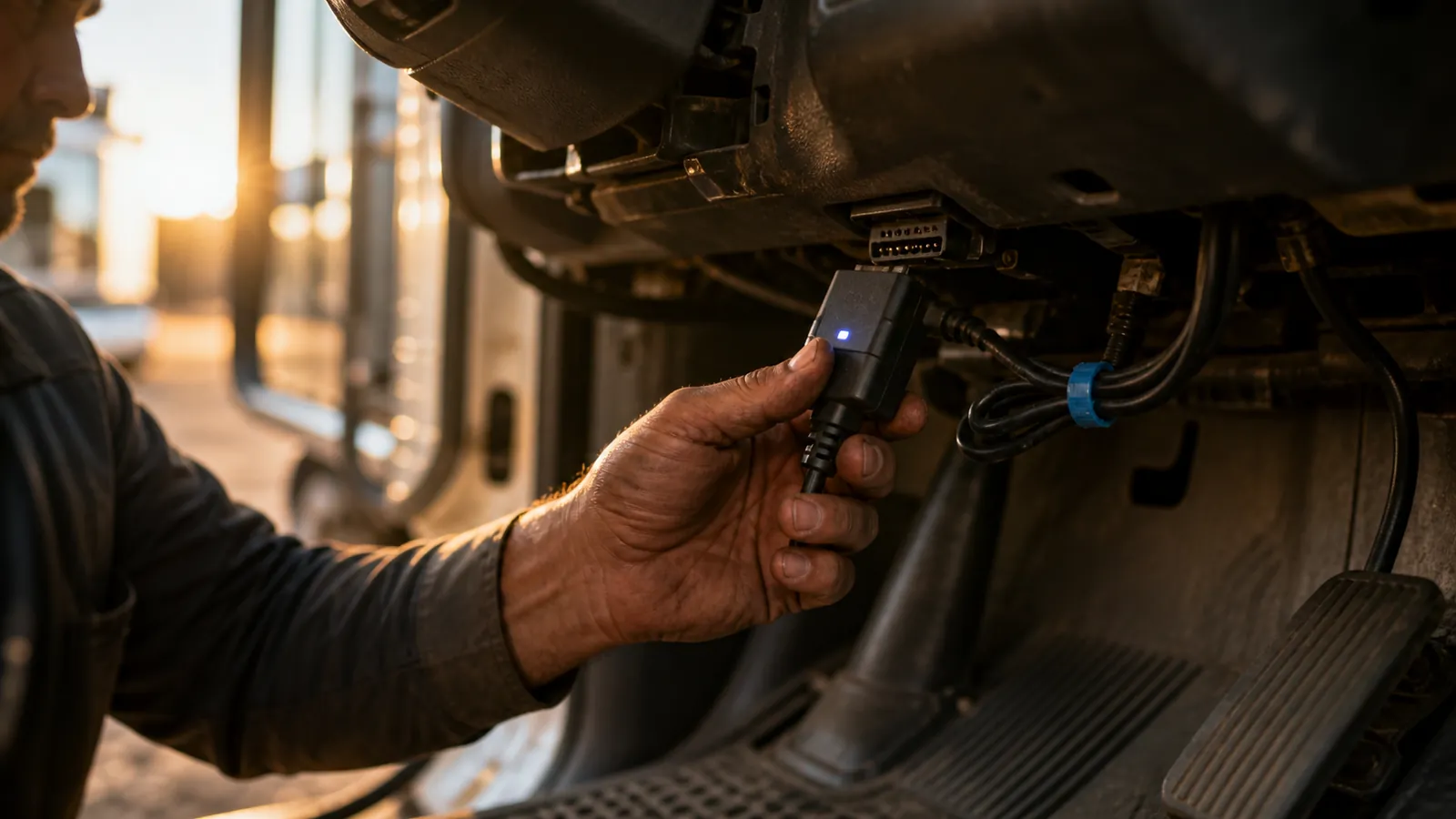
The vehicle rule. Under 49 CFR 395.8(a)(1)(ii)(A)(4), drivers of commercial motor vehicles manufactured before model year 2000 may keep handwritten RODS instead of using an ELD. The rule ties the model year to the vehicle identification number as shown on the vehicle's registration. "Pre-2000" means manufactured before model year 2000 — a model-year-2000 vehicle does not qualify. This is rule text, and every other hours-of-service duty remains in place. It is also assessed vehicle by vehicle: a two-truck operation with one qualifying truck and one that does not runs two different answers at the same time, and the newer truck goes back through the Four-Gate ELD Test on its own.
One citation note, because it causes real confusion: several FMCSA guidance documents on this topic still cite the exceptions at 395.8(a)(1)(iii), which was their location before the section was renumbered. In the current eCFR text they sit at 395.8(a)(1)(ii)(A)(1) through (4). The regulation itself has not fully caught up either — 49 CFR 395.11(d)(4), on toll receipts for paper-log periods, still cross-references the old paragraph. If a guidance page and the regulation appear to disagree about the subparagraph, the current regulation text is the one to work from.
The engine guidance. FMCSA's pre-2000 model year exception guidance accepts certain vehicles whose VIN shows a later model year but whose engine predates model year 2000 — the common glider-kit and engine-swap situations. Under the guidance, the driver is not required to carry documentation confirming the engine's model year, but the motor carrier must retain documentation of motor and engine changes at its principal place of business, a duty the guidance traces to 49 CFR part 379 appendix A. Label this path honestly in your own records: the regulation text names the vehicle's model year, and the engine-year treatment is agency guidance that expands on it. If your engine swap is real but your paperwork is thin, fix the paperwork before you rely on the path — an engine plate photo and the rebuild or purchase documentation are the kind of evidence the guidance contemplates.
The ECM misconception. A model-year-2000-or-newer vehicle without a functioning engine control module is not excepted from the ELD requirement on that basis. FMCSA's general ELD-rule information makes the point plainly: ELDs exist that do not depend on ECM connectivity, and one may be required for your truck even if a vendor's standard hardware will not plug in. "My truck has no computer" is a device-selection problem, not an exemption.
If your operation qualifies under the vehicle rule or the engine guidance, remember what survives: handwritten RODS whenever RODS are required, the 8-in-30 arithmetic if you are also leaning on that path for a second vehicle, and the full set of hours-of-service limits.
Before you rely on this path, confirm:
- Does the VIN on the registration show a model year before 2000, rather than a build date or a rebuild year?
- If you are using the engine path, is the engine's model year documented at your principal place of business — and does the document identify the engine, not just the rebuild?
- Are blank graph-grid RODS forms actually in the truck, since every required-RODS day now runs on paper?
Driveaway-towaway, rental trucks, agriculture, and state rules
Driveaway-towaway
Two ELD exceptions cover driveaway-towaway work: when the vehicle being driven is part of the shipment being delivered, and when the vehicle being transported is a motor home or a recreational vehicle trailer (49 CFR 395.8(a)(1)(ii)(A)(2)–(3)). The operation must actually match the driveaway-towaway definition in 49 CFR 390.5T, which turns on an empty or unladen motor vehicle with one or more sets of wheels on the roadway being transported between specified points — manufacturer to dealer, dealer to purchaser, to a repair facility after disabling damage or a component failure, or by saddle-mount or tow-bar. Ordinary bobtailing, repositioning equipment between yards, or driving a truck to a terminal is not automatically driveaway-towaway just because the truck is empty. Handwritten RODS remain required when RODS are due, and nothing about the exception relaxes the driving-time limits.
Before you rely on this path, confirm:
- Is the vehicle you are moving the commodity being delivered, or is it your own equipment being repositioned?
- Does the movement match one of the specific point-to-point situations in the definition?
Renting a truck for 8 days or fewer
An active limited FMCSA exemption covers drivers of property-carrying CMVs operated under a rental agreement of 8 days or fewer, regardless of the reason for the rental. It is dated relief, not a rule: the renewed exemption runs from October 12, 2022 through October 12, 2027, 11:59 p.m. local time, unless renewed or rescinded, and FMCSA renewed it provisionally.
Its conditions are stricter than most summaries suggest, and three of them are where operators come unstuck.
You must carry the exemption notice, not just the rental agreement. Drivers must have a copy of the exemption notice in their possession while operating under it and present it to law enforcement on request. Separately, a copy of the rental agreement must be in the CMV and available on request, and it must clearly identify the parties to the agreement, the vehicle, and the dates of the rental period. Drivers must also possess RODS for the current day and the prior seven days where RODS were required on those days. Print the notice before the truck moves; it is not something you can produce at roadside from a phone in a dead zone.
Cycling rentals voids it. Evidence that a carrier has replaced one rental CMV with another on eight-day cycles, or attempted to renew a rental agreement for the same CMV for an additional eight days, is treated as a violation of the exemption and subjects the carrier and driver to the penalties for failing to use an ELD. The eight-day limit is a ceiling on the operation, not a renewable unit.
A crash triggers a reporting duty. Carriers operating under the exemption must notify FMCSA within five business days of any accident involving a driver operating under its terms, with the identity of the exemption, the accident details, the driver and vehicle information, injuries and fatalities, the police-reported cause, any citations, and the driver's total driving and on-duty time before the accident.
Two further points. The exemption excuses the device, not the log: on any day RODS were otherwise required, that day is still a required-RODS day for your rolling 8-in-30 count, so a full rental week can leave you close to a ninth day just as the rental ends. And if you also run intrastate, note that the exemption preempts conflicting state enforcement as to interstate commerce, but states may, and are not required to, adopt the same exemption for intrastate operations.
Before you rely on this path, confirm:
- Do you have the exemption notice itself in the vehicle, in addition to the rental agreement?
- Does the agreement name the parties, the vehicle, and the exact rental dates?
- Is this rental a renewal or a replacement of a prior eight-day rental of the same or another CMV?
Agricultural operations
Agricultural relief under Part 395 is real, and it is broader than the other paths on this page — where it applies, the whole part stops applying, so there is no RODS duty and no device. It is also narrower than "I have farm plates." Under 49 CFR 395.1(k), the provisions of Part 395 do not apply during planting and harvesting periods, as determined by each State, to drivers transporting:
- agricultural commodities from the source of those commodities to a location within a 150-air-mile radius of the source;
- farm supplies for agricultural purposes from a wholesale or retail distribution point to a farm or other location where they will be used, within a 150-air-mile radius of that distribution point;
- farm supplies for agricultural purposes from a wholesale distribution point to a retail distribution point, within a 150-air-mile radius of the wholesale point; or
- livestock within a 150-air-mile radius of the final destination of the livestock.
Most real disputes about this exemption turn on the season and on the centre of the circle. The season is a state determination sitting inside a federal exemption — the relief runs "during planting and harvesting periods, as determined by each State," so the dates that switch it on and off are not federal and are not the same everywhere. And the radius is measured from the source of the commodity, from the distribution point, or from the livestock's final destination depending on which category you are in — never from your normal work reporting location, which is where the short-haul exception measures from. Same number, different centre of the circle. Get oriented with FMCSA's agriculture exemptions guidance, then match your exact facts against the rule text before running without logs.
Before you rely on this path, confirm:
- Which radius applies to your movement, measured from where?
- Has your State declared a planting or harvesting period covering the dates you are running, and can you show which one?
- Does the commodity, the source, and the operation type all fall inside the specific exemption you are claiming, on this trip?
If you run intrastate only
Everything above is federal. An intrastate-only operation — one that never participates in interstate commerce — is governed by its state's rules, and state adoption of ELD and hours-of-service requirements differs. First Load HQ does not infer state requirements. It publishes a state conclusion only where that state's own agency states the rule on its own current page, and routes you to the agency everywhere else. Do not treat this page's federal analysis as an answer for intrastate work in any state.
What the federal framework does tell you is the shape of the answer. States receiving Motor Carrier Safety Assistance Program funding must adopt and enforce intrastate rules compatible with the Federal Motor Carrier Safety Regulations, no later than three years after any addition or amendment to them, and the permitted intrastate variances are a short, closed list. Under 49 CFR 350.305, those variances are the complete set of ways a state's intrastate hours-of-service rules may differ from the federal ones:
| Permitted variance | What a state may allow instead of the federal rule |
|---|---|
| Daily driving and duty limit | A 12-hour driving limit, with no driving after 16 hours on duty |
| Weekly on-duty limit | A prohibition on driving after 70 hours on duty in 7 days, or 80 hours in 8 days |
| Short-haul radius | A 150-air-mile radius, or the radius under § 395.1(e)(1)(i), whichever is greater |
| Minimum driver age | Intrastate CMV drivers must be at least 18 |
| Vehicles under 26,001 pounds | A state may exempt a CMV from all or part of its intrastate laws and regulations where the gross vehicle weight rating, gross combination weight rating, gross vehicle weight, or gross combination weight does not reach 26,001 pounds — but not if the vehicle carries placarded hazardous materials or is designed or used to carry 16 or more people |
| Anything else | Not permitted as of right — the state must apply to FMCSA for a further variance |
That last row is the one that surprises people. The federal commercial motor vehicle line sits at 10,001 pounds, but a state is permitted to draw its intrastate line at 26,001 pounds, so the same truck can be a regulated CMV on an interstate run and outside the state's intrastate rules entirely on a local one. It is permission, not a requirement — some states use it, some do not, and only the state's adopted rule says which.
So expect your state's intrastate hours-of-service rules to track Part 395 closely, possibly with one of those variances — but whether your state adopted the ELD requirement itself for intrastate carriers is a question only your state's adopted rule answers. Those are two separate adoptions, and states have treated them differently.
How to find the intrastate ELD rule in your state
This page does not publish a fifty-state answer, because a fifty-state answer that is not sourced to fifty state agencies is guesswork with a table around it. What it publishes is every jurisdiction it has verified — two of them, so far — and a named route for every jurisdiction it has not.
| Jurisdiction | Governing authority for intrastate CMV hours and ELD rules | What First Load HQ has verified | Status and date checked |
|---|---|---|---|
| California | California Highway Patrol | Intrastate motor carriers and drivers must use an ELD to record RODS under 13 CCR § 1213(a)(1) unless otherwise exempted; 13 CCR § 1213.3 adopts the federal ELD regulations in 49 CFR Part 395, subpart B for both interstate and intrastate carriers; effective January 1, 2024, with no grace period or soft start; 13 CCR § 1213(a)(3) carries an exception for drivers completing RODS on no more than 8 days in any 30-day period | Verified • CHP intrastate ELD page • checked August 9, 2026 |
| New York | New York State Department of Transportation | The Commissioner of Transportation adopts 49 CFR Part 395 for motor carriers and drivers operating in intrastate commerce under 17 NYCRR § 820.6(b), subject to stated exceptions including certain farmer-owned vehicles hauling farm, dairy or horticultural products and farm supplies; Part 395 subpart B is the subpart containing the ELD requirement | Verified with limitation • NYSDOT publication of 17 NYCRR Part 820 • checked August 9, 2026 — read the current rule text for the full exception list before relying on one |
| The other 48 states and the District of Columbia | Your state's lead agency for commercial motor vehicle safety — in most states a state police, highway patrol, department of transportation, or department of public safety unit | Nothing. First Load HQ has not verified intrastate ELD adoption in these jurisdictions and publishes no conclusion for them. Do not read the California or New York rows as a national answer | Not verified • route to the agency below • checked August 9, 2026 |
Work it in this order:
- Identify the agency. Every state has a lead agency responsible for reviewing and analyzing state CMV safety laws for compatibility. If you do not know which agency that is in your state, FMCSA's field offices directory lists a division office for every state, and that office can point you to the state lead agency. FMCSA's information line is 1-800-832-5660.
- Find the adopted rule, not a summary. Ask specifically whether the state has adopted 49 CFR part 395, and whether it has adopted subpart B — the ELD subpart — for intrastate carriers, or carved it out. Ask for the citation to the state regulation, the way the California row above cites 13 CCR § 1213.
- Confirm the variance. If the state's rule differs from the federal one, check which of the four permitted variances in the table above it is using, because that tells you what your daily and weekly limits actually are.
Third-party summaries of state ELD adoption are common and are frequently out of date; several still describe bills that were introduced and never enacted. Whatever you are told, the citation to the state's own adopted regulation is the thing to get in writing.
Before you rely on this path, confirm:
- Which agency in your state governs intrastate motor carrier safety rules, and where is its adopted rule published?
- Has your state adopted the ELD subpart for intrastate carriers, or only the hours-of-service sections?
- Does any part of your work — a single delivery that begins or ends outside the state, or freight in the flow of interstate commerce — put you in interstate commerce anyway?
Does a hotshot driver need an ELD?
Sometimes — and the deciding facts are weight, interstate commerce, and RODS frequency, not CDL status. A three-quarter-ton or one-ton pickup pulling a gooseneck routinely crosses 10,001 pounds as a combination, which makes it a federal commercial motor vehicle in interstate commerce whether or not the driver holds a CDL. From there the analysis is identical to any other operation: work the Four-Gate ELD Test, then find your situation in the operator router above.
Hotshot operators get this wrong in both directions. "I don't need a CDL, so the ELD rule doesn't apply" is wrong; "I'm a commercial truck, so I obviously need an ELD" is often wrong too, because a genuinely local hotshot operation may qualify for short-haul days — including the non-CDL short-haul provision written for exactly this vehicle class — and an occasional one may sit inside 8-in-30. Run the gates before assuming either way.
When an ELD is required: device checks, removals, and malfunctions
Before the mechanics, the stake. An hours-of-service or ELD violation found at roadside is written against the driver and the motor carrier, and roadside inspection and violation history attaches to the carrier's USDOT number, where FMCSA publishes it as company safety data. If you hold your own authority, that record is yours, it follows the USDOT number rather than the truck, and brokers and insurers can read it.
That record behaves in ways worth understanding before you decide a load is worth the risk. FMCSA's Safety Measurement System uses the previous 24 months of roadside inspection data, and each violation carries its own severity weight rather than counting once — so a violation written today is still inside the calculation two years from now, and the weight it carries is not the same as the next one's. And when you hold your own authority you are both parties: the violation is written against the driver and against the motor carrier, and you are both of them. That is the reason to get the device question right before a load rather than after an inspection.
If a violation is recorded against you in error — the wrong USDOT number, an inspection that was not yours, a citation that was later dismissed — the route is a Request for Data Review through FMCSA's DataQs system, not an argument at the scale. FMCSA revised the program in April 2026: states receiving MCSAP funding must follow a three-step independent review, designate points of contact for inspection and crash requests, and review requests submitted within three years of an inspection and within five years of a crash. Under the SMS methodology, where the citation attached to a violation was dismissed or reduced in a judicial proceeding, certified documentation of that outcome submitted through a Request for Data Review can remove the violation from the calculation or drop its severity weight to one. None of that removes a violation you earned. It removes one you did not.
An ELD is not just any tracking device. Under 49 CFR 395.2, an electronic logging device is a device or technology that automatically records a driver's driving time and facilitates accurate recording of hours of service, and that meets the requirements of subpart B of Part 395. A fleet-tracking app, a broker's load-tracking app, and a dash camera are none of those things.
If the gates land on "device required," the first purchase step is not a purchase. Under 49 CFR 395.22(a), a motor carrier required to use an ELD must use only a device listed on FMCSA's registered ELDs list — so verify the exact model and software version on the FMCSA registered ELD list before money moves. The list is made of devices that providers have self-certified and registered with FMCSA; FMCSA does not approve devices, and it can remove a listed device that fails to meet the technical requirements in appendix A to subpart B of part 395. A brand name is not a status — providers register specific models and versions, and a provider can have one listed device and one removed one.
Once a device is in service, 49 CFR 395.22(h) requires the driver to have an ELD information packet onboard: an instruction sheet describing the data transfer mechanisms the device supports and how to produce and transfer records to a safety official, an instruction sheet describing malfunction reporting and recordkeeping procedures, and a supply of blank graph-grid RODS sufficient for at least 8 days. The paper logs are part of the equipment. Note that the requirement to keep the ELD operator's manual in the vehicle was rescinded effective July 22, 2026 — the other three items remain.
Devices removed from the FMCSA list
Removal is the operational risk that makes this a recurring check rather than a one-time box, and it is not rare. In its May 20, 2026 removal notice, FMCSA stated it had removed 79 devices since January 2025 for failing to meet the federal standards. Five separate removal actions were published between April and July 2026 alone. When FMCSA removes a device, motor carriers generally have up to 60 days to replace it; after that deadline, continuing to use it violates 49 CFR 395.8(a)(1) — no record of duty status — and the driver is placed out of service under the Commercial Vehicle Safety Alliance out-of-service criteria.
| Removal date | Devices removed | Replace by | Status as of August 9, 2026 |
|---|---|---|---|
| July 9, 2026 | 10 listings, including Ontime Logs iosix, LAST MINUTE ELD, Porter ELD, Zee HOS Compliance and TT ELD 40 | September 8, 2026 | Replacement window open |
| June 23, 2026 | TRUCKSTAFF ELD | August 23, 2026 | Replacement window open |
| May 20, 2026 | 12 listings, including 888 ELD, DRAGON ELD, ACTION ELD, FIRST ELD and COBRA ELD | July 20, 2026 | Window closed; out-of-service enforcement in effect |
| May 7, 2026 | Safe ELD (iOS and Android) and MYLOGS ELD | July 7, 2026 | Window closed; out-of-service enforcement in effect |
| April 2, 2026 | HERO ELD | June 2, 2026 | Window closed; out-of-service enforcement in effect |
Source: FMCSA's ELD news and events notices, which carry the complete device names, model numbers and ELD identifiers for each action. Check that page rather than this table before you buy — this is a snapshot, and the list above is current only to the verification date at the top of this page.
Three things follow. A removal transition period is an instruction for switching, not evidence the device is still registered. If a provider corrects the identified deficiencies FMCSA can put a device back on the list, so "removed" is not always permanent — but you cannot operate on the expectation that it will be reversed. And the compliance duty under 395.22(a) sits with the motor carrier, not the provider, so use the notification channel you control: subscribe to FMCSA email updates and removal notices reach you directly. It is free, takes a minute, and is the most useful thing to do in the ten minutes after buying a device.
If you work the gates and find you have been operating without a device you needed, deal with the exposure honestly. The days already run cannot be repaired: writing up records after the fact so they read as contemporaneous is a false report in connection with duty status, prohibited by 49 CFR 395.8(e)(1), and it converts a paperwork violation into a far more serious one. What you can do is stop the exposure: get a listed model and version in service before the next required-RODS day, and if you genuinely qualify for one of the exceptions in the meantime, use it and keep the records it requires. If you do not qualify for any of them, the honest position is that you are not compliant until the device is working, and planning around that is cheaper than being found out at a scale. If the exposure is large, or a customer or insurer has already asked about it, this is the point to put a transportation attorney on it rather than a compliance vendor — the question stops being which device to buy and becomes what you say, to whom, and when.
When your ELD malfunctions
Malfunctions have their own workflow, and it is a transition procedure, not an exemption. Under 49 CFR 395.34 and FMCSA's malfunction and data-diagnostic FAQs, the driver notifies the motor carrier in writing within 24 hours, reconstructs RODS for the current 24-hour period and the previous 7 consecutive days on paper unless they can be retrieved from the device, and keeps paper logs until the ELD is back in service. The carrier must repair, service, or replace the malfunctioning device within 8 days of discovering the condition or the driver's notification, whichever comes first, and may seek an extension from the FMCSA Division Administrator for the state of its principal place of business — but that request must be made within 5 days of the driver's notification, so it is a decision to make in the first days of a breakdown, not the second week.
What is not an exemption
Several things drivers commonly treat as exemptions are not. Two of them are special driving categories rather than exceptions: personal conveyance is off-duty movement of a CMV for the driver's own purposes when properly authorized by the carrier, and a yard move is on-duty movement within a confined property configured as such on the device. Both are recorded on the ELD; neither removes the requirement to have one. Out-of-service means an enforcement officer has declared a driver, vehicle or operation may not proceed until the condition is corrected.
| Item | Correct treatment |
|---|---|
| ELD malfunction | Temporary paper-log procedure plus notification and the repair-or-replace workflow above — never a permanent exception. |
| Removed device | Follow the FMCSA replacement notice and deadline; do not describe the device as currently listed after removal. |
| Personal conveyance | A special driving category when properly authorized and used — not an exemption from having an ELD when one is otherwise required. |
| Yard move | A special driving category and configuration — not an ELD exemption. |
| Broker tracking app | A private counterparty's policy; it neither substitutes for nor expands federal ELD law. |
| No ECM on a newer vehicle | Not an exception by itself; a compliant ELD that does not depend on ECM connectivity may be required. |
Only after the exact model and version checks out on the official list does comparison shopping make sense — the next section shows how to build the shortlist.
Choosing an ELD at a glance
These picks describe what to shortlist, not who to buy from — this page names no vendors, and the named comparison belongs to compare registered ELD options. Segment yourself first:
- Best for routine interstate RODS operations: a device whose exact model and version appears on the current FMCSA list, with month-to-month terms and a published all-in hardware cost — a full-time logging operation should not carry contract risk on top of compliance risk.
- Best for drivers near the 8-in-30 line: a no-long-term-contract device you can put in service quickly, so the ninth-day decision does not lock you into a multi-year cost for occasional use.
- Best for older or non-ECM trucks that still need a device: a listed model documented to work without ECM connectivity for your vehicle — confirm the fit in writing before paying.
- Wait — complete the Four-Gate ELD Test and the official list check first if you have not confirmed a RODS duty: qualifying short-haul, 8-in-30, model-year, and active-exemption operations may need no device at all today.
| Your situation | Shortlist move | Confirm before you sign or pay |
|---|---|---|
| New authority, routine interstate RODS days ahead | Shortlist listed devices with month-to-month terms and published total cost. | Contract length and early-termination fee; total hardware plus monthly cost including add-ons; exact model and version on the current FMCSA list; what the provider does if its device is removed. |
| Mostly short-haul, occasionally over the line | Track your rolling required-RODS count first; shortlist only if a ninth day is realistically coming. | Whether you can activate quickly before a ninth day; cancellation terms if your count drops; data-export and account-closure terms. |
| Older truck or engine-swap vehicle | Confirm the model-year or engine-guidance path and its documentation before shortlisting anything. | Whether a device is legally required at all; if it is, non-ECM installation support in writing; malfunction support and transfer workflow. |
Apply the same scorecard to every provider you evaluate: the device-check questions in the section above — exact model and version on the current list, removal contingency, malfunction support — are the per-provider checklist. Do not accept less evidence from one vendor than you demand from another.
Frequently asked questions
Does an older engine qualify if the truck itself is newer?
It can, under FMCSA guidance rather than the rule text. The guidance accepts engines predating model year 2000 in later-VIN trucks — common with glider kits and engine swaps — when the motor carrier retains documentation of motor and engine changes at its principal place of business. Handwritten RODS are still due whenever RODS are required, and thin documentation is the usual failure point.
What do I have to carry for the rental-truck ELD exemption?
Three things, not one. A copy of the FMCSA exemption notice in your possession, produced to law enforcement on request; a copy of the rental agreement in the vehicle, clearly identifying the parties, the vehicle and the rental dates; and your RODS for the current day and the prior seven days where they were required. Carrying only the rental agreement is the common failure. Cycling rentals to stay inside the eight-day limit is treated as a violation of the exemption.
Can I use paper logs while my ELD is broken?
Yes — temporarily, under the malfunction procedure. Notify your carrier in writing within 24 hours, reconstruct the current day and previous 7 days on paper unless the data is retrievable, and keep paper logs until the device is back in service; the carrier has 8 days to repair or replace it, and any extension request must reach the FMCSA Division Administrator within 5 days of your notification. A malfunction is a transition procedure, not an exemption.
How long do I have to get an ELD once one is required?
There is no single grace period — the clock is set by the tightest deadline you are actually under. Approaching a ninth required-RODS day in a rolling 30-day window means the device must be installed and working before that day. A removed device runs on the deadline in FMCSA's replacement notice, typically 60 days from removal. A malfunction runs on the 8-day repair-or-replace window. Plan procurement, installation, account setup, and driver familiarity against the earliest of those, not against a vendor's shipping estimate.
What does it cost to use an ELD exemption or check the official list?
Nothing at the federal level as of August 9, 2026: FMCSA charges no fee to claim an exception, keep time records or handwritten RODS, check the registered ELD list, or subscribe to its removal notices. The costs that exist are commercial — device hardware, subscriptions, and contract terms — and those are vendor terms, not government fees.
Your next step

Three moves, in order. First, verify your rule path: work the Four-Gate ELD Test against current 49 CFR Part 395 and document the answer. Second, document the exception you are relying on and the records that remain — time records for short-haul, the Four-Field RODS-Day Ledger for 8-in-30, engine or rental paperwork where applicable. Third, only if a device is required, verify the exact model and version on FMCSA's registered list, subscribe to its removal notices, then compare options. Clearing the ELD question does not clear your other federal duties — enrollment in a testing program runs on its own track; see owner-operator drug and alcohol compliance. Keep the whole startup sequence straight with the authority-to-first-load checklist, and put your renewals on the owner-operator compliance calendar.
Sources and last verified date
Last verified: August 9, 2026 Next review: September 9, 2026 (registry and removals); November 9, 2026 (full rules review)
About this page. First Load HQ is an independent educational publisher. It is not FMCSA, DOT, a law firm, an insurance agency, or a motor carrier registration service, and it files nothing on anyone's behalf. This page carries no affiliate links and no sponsored placement; no ELD provider paid for anything on it, and no provider is named on it. Every rule below is linked to the current federal text or to the issuing agency's own page so you can check it yourself. Federal rule text and the device registry are re-checked on the schedule published in the matrix above, and on every FMCSA device-removal notice. Corrections go to hello@firstloadhq.com.
- eCFR — 49 CFR Part 395, Hours of Service of Drivers — the governing part for record-of-duty-status and ELD requirements.
- eCFR — 49 CFR 395.2, Definitions — the federal definition of an electronic logging device.
- eCFR — 49 CFR 395.1, Scope of rules in this part — short-haul conditions and the six-month time-record duty (395.1(e)(1)), the non-CDL short-haul provision (395.1(e)(2)), and the agricultural operations exemption (395.1(k)).
- eCFR — 49 CFR 395.3, Maximum driving time for property-carrying vehicles — the driving and weekly on-duty limits that survive the short-haul exception, and the 30-minute interruption exception for short-haul drivers at 395.3(a)(3)(ii).
- eCFR — 49 CFR 395.8, Driver's record of duty status — the manual-RODS exceptions at 395.8(a)(1)(ii)(A)(1)–(4), the duplicate-record requirement, and the false-report prohibition at 395.8(e)(1).
- eCFR — 49 CFR 395.11, Supporting documents — the supporting-document categories, and the stale cross-reference to 395.8(a)(1)(iii) at 395.11(d)(4).
- eCFR — 49 CFR 395.22, Motor carrier responsibilities—In general — the registered-device requirement (395.22(a)) and the onboard ELD information packet (395.22(h)), as amended June 22, 2026.
- eCFR — 49 CFR 395.34, ELD malfunctions and data diagnostic events — driver notification, paper-log reconstruction, the 8-day repair window, and the 5-day extension request.
- eCFR — Appendix A to Subpart B of Part 395 — the minimum technical requirements a registered device must meet.
- eCFR — 49 CFR 390.5T, Definitions — the operative federal commercial motor vehicle threshold, interstate commerce, and driveaway-towaway definitions. Section 390.5 is suspended indefinitely as of July 21, 2026.
- eCFR — 49 CFR 350.305, Compatibility review: Allowable variances from the FMCSRs — the closed list of hours-of-service variances a state may apply to intrastate transportation, and the 26,001-pound intrastate exemption a state is permitted to grant at 350.305(a).
- General Information about the ELD Rule — FMCSA — plain-language applicability, exception summary, and the no-ECM clarification.
- FMCSA registered, self-certified ELD list — the official device list checked at gate 4.
- ELD news and events — FMCSA — dated device-removal notices, replacement deadlines, and out-of-service enforcement dates.
- FMCSA removes 12 devices from the list of registered ELDs (May 20, 2026) — the July 20, 2026 replacement deadline and the count of 79 devices removed since January 2025.
- FMCSA removes 10 devices from the list of registered ELDs (July 9, 2026) — the most recent removal action and its September 8, 2026 replacement deadline.
- ELD Exceptions and Exemptions FAQs — FMCSA — rolling 30-day clarification and special-case guidance.
- ELD Malfunctions and Data Diagnostic Events FAQs — FMCSA — driver notification and paper-log fallback during a malfunction.
- When Does the Pre-2000 Model Year Exception Apply? — FMCSA — VIN and registration treatment, older engines in later vehicles, and the part 379 appendix A record-retention duty.
- ELD Hours of Service (HOS) and Agriculture Exemptions — FMCSA — scope orientation for agricultural-commodity and covered-farm-vehicle relief.
- Hours of Service of Drivers: TRALA Application for Exemption Renewal, 87 FR 55887 (Sept. 12, 2022) — the rental-CMV exemption's scope, five terms and conditions, accident-notification duty, preemption note, and October 12, 2027 expiry.
- Electronic Logging Device Revisions, advance notice of proposed rulemaking (Sept. 16, 2022) — the five areas FMCSA sought comment on, including pre-2000 engine applicability and the device-removal process.
- Rescinding the Requirement for Electronic Logging Device Operator's Manual Located in Commercial Motor Vehicles — final rule (June 22, 2026) — the July 22, 2026 change to the onboard information packet.
- Safety Measurement System Methodology — FMCSA CSA — the 24-month roadside inspection window, violation severity weighting, and the adjudicated-citation treatment of dismissed or reduced citations.
- FMCSA upgrades DataQs program (April 2026) — FMCSA — the three-step independent review, state points of contact, and the three-year inspection and five-year crash review windows.
- Intrastate Electronic Logging Devices — California Highway Patrol — California's intrastate ELD requirement, its 13 CCR citations, its January 1, 2024 effective date, and its 8-days-in-30 exception.
- 17 NYCRR Part 820, Safe Operations of Commercial Motor Vehicles by Motor Carriers and Drivers — New York State Department of Transportation — New York's adoption of 49 CFR Part 395 for intrastate commerce at § 820.6(b) and its stated exceptions.
- FMCSA field offices directory — division office in every state, used as the routing target for intrastate questions.
- FMCSA company safety data — where roadside inspection and violation history attached to a USDOT number is published.
- FMCSA email updates subscription — the official channel for ELD removal notices.
Not sure what fits your situation?
Answer a few questions and get a shortlist matched to where you are right now.
Take the 2-minute questionnaireKeep reading
 How to Get Trucking Authority: Rules, Steps & StatusLearn how to get trucking authority through the current FMCSA process, complete BOC-3 and insurance filings, check active status, and avoid costly delays.
 Best ELDs for Owner-Operators: 4 Options ComparedCompare four current ELD options for owner-operators by exact registered model, total cost, contract, support and fit, including hotshot use.
 DOT Drug and Alcohol Consortium for Owner-OperatorsSee when an owner-operator needs a DOT drug and alcohol consortium, how Clearinghouse registration and self-queries work, and which tests come next.
 New Trucking Company Checklist: Authority to First LoadUse this new trucking company checklist to verify authority, insurance, UCR, driver compliance, equipment, broker paperwork, and first-load readiness.